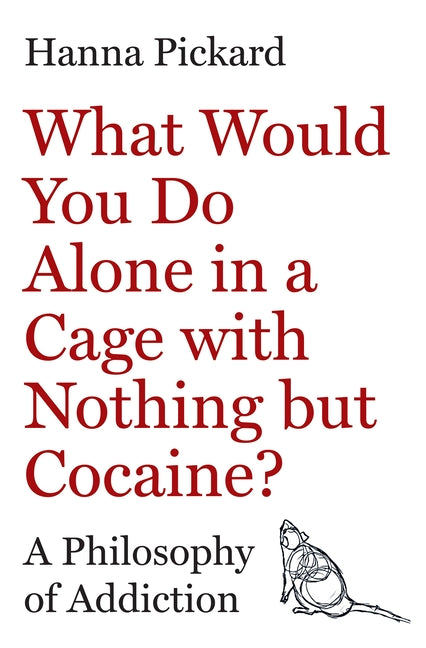
What Would You Do Alone in a Cage with Nothing But Cocaine?: A Philosophy of Addiction


What Would You Do Alone in a Cage with Nothing But Cocaine?: A Philosophy of Addiction
What Would You Do Alone in a Cage with Nothing But Cocaine?: A Philosophy of Addiction
Description
Description
A revolutionary new paradigm for understanding addiction
Why do people with addiction use drugs self-destructively? Why don't they quit out of self-concern? Why does the rat in the experiment, alone in a cage, press the lever again and again for cocaine--to the point of death? In this pathbreaking book, Hanna Pickard proposes a new paradigm for understanding the puzzle of addiction. For too long, our thinking has been hostage to a false dichotomy: either addiction is a brain disease, or it is a moral failing. Pickard argues that it is neither, and that both models stifle addiction research and fail people who need help. Drawing on her expertise as an academic philosopher and her clinical work in a therapeutic community, Pickard explores the meaning of drugs for people with addiction and the diverse factors that keep them using despite the costs. People use drugs to cope with suffering--but also to self-harm, or even to die. Some identify as "addicts," while others are in denial or struggle with cravings and self-control. Social, cultural, and economic circumstances are crucial to explaining addiction--but brain pathology may also matter. By integrating addiction science with philosophy, clinical practice, and the psychology and voices of people with addiction themselves, Pickard shows why there is no one-size-fits-all theory or ethics of addiction. The result is a heterogeneous and humanistic paradigm for understanding and treating addiction, and a fresh way of thinking about responsibility, blame, and relationships with people who use drugs.
About the Author
About the Author
Hanna Pickard is Bloomberg Distinguished Professor of Philosophy and Bioethics and Krieger-Eisenhower Professor at Johns Hopkins University.
Critical Reviews
Critical Reviews
"Anyone confronting addiction would do well to read Hanna Pickard's new book, which should change how ordinary people and clinicians think about it. One important insight is that often a cure for addiction depends on the addict finding a new identity, other than that of being an addict. This is a book by a philosopher, based on experience in a therapeutic setting, that has the actual potential to save lives."---Brian Leiter, Leiter Reports
"Pickard convincingly shows that while the diseased brain model aimed to destigmatize addiction, it has largely failed to do so while amplifying some addicts' pessimism about recovery. Addiction researchers and clinicians will be enlightened."-- "Publishers Weekly"
"[This book] has changed my understanding of my habits--and maybe it will change yours, too."---Jacob Rosenberg, Mother Jones
"A brilliant and compelling contribution...that has the potential to reframe the public's understanding of drug use and addiction. . . . It is a text rooted in radical compassion that supports autonomy, promotes responsibility without blame, and highlights the various factors that can cause and maintain an individual's substance use over time."---Cassandra L. Boness, Science
Publishing Information
Publishing Information
Publisher:
Princeton University Press
Pub date:
2026-01-06
Length:
352 pages

The Allstora Membership
Membership Perks:
- Save 30% on all online store purchases
- Exclusive access to author's content
- You pay less, but authors still earn double
Membership Terms:
First Month:
$0.00
Monthly price:
$5.00
- To access membership discount simply log in and add to cart, discount applied automatically.
- One month free trial, cancel anytime. Membership renews on the 15th of each month.