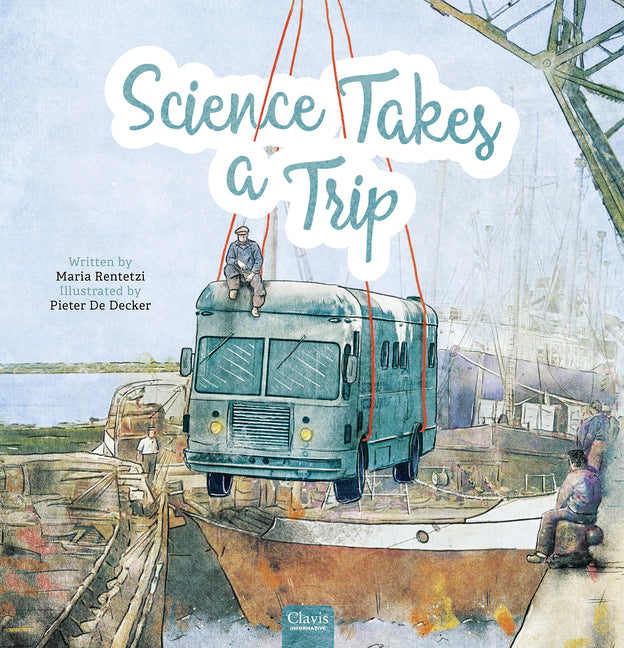
Science Takes a Trip

Maria Rentetzi

Book cover for Science Takes a Trip
Image for variant 9798890632456
Book cover for Science Takes a Trip
Image for variant 9798890632456

Science Takes a Trip

Science Takes a Trip

Maria Rentetzi

View full details

Description

"An enthralling historical account." - Kirkus Reviews


Recommended for library collections and social studies classrooms." - School Library Journal


Journey into history with science and adventure! Step back to the 1950s, where world-changing innovations and the pursuit of peace take center stage. Learn how the United States once donated two blue laboratory buses to carry nuclear science across the globe with the goal of bringing hope and progress to the world after the devastation of World War II. Despite many difficulties, a team of dedicated scientists used these labs to help shape history, bridging gaps between nations in the hope of building a brighter future.

Based on historical and scientific facts, it was written by Maria Rentetzi, professor in science, technology and gender studies at the Friedrich-Alexander University of Erlangen-Nuremberg in Germany.


A beautifully illustrated, informative book about a little-known piece of history: two mobile laboratories that brought together scientists from around the world in the aftermath of World War II. For curious readers ages 9 years and up.


About the Author

Maria Rentetzi is an experienced academic author, but "Science Takes a Trip" is her first book for children. With a background in physics and science history, she's currently a professor and chair of Science, Technology and Gender Studies at the Friedrich Alexander University of Erlangen-Nuremberg in Germany. She's very passionate about picture books and wants to make her academic stories about nuclear science and technology accessible for children.

Pieter De Decker is a versatile illustrator, designer, and artist based in Belgium. His work spans a broad range of projects, including illustrations, public art integrations, light installations, and theater projects for children. His illustrations exude a vibrant depth, inviting viewers to continually discover new details. Pieter creates atmospheres that inspire and captivate audiences of all ages.


Critical Reviews

"What visited 16 countries and trained 1,500 scientists from 1958 to 1965? The answer is two mobile laboratories donated to the International Atomic Energy Agency (IAEA) by the United States. This middle grade picture book tells a forgotten piece of history from the Cold War era. Readers learn that these buses were equipped with "a chemical laboratory and a radiation measurement chamber" and large enough to train six people at a time. Beautiful illustrations capture moments along the journey, such as one of the labs being lifted by crane onto a freighter, or a lab on the street in Southeast Asia being passed by bicycles and rickshaws. Some illustrations fill the entire spread, while others fill just one page, and the facing page holds text and several smaller images. Back matter includes photos from the IAEA archives and a brief synopsis of the program. There is also a QR code to access a video from the author about her research into the topic. This is a very useful book to include in social studies units on the Cold War and the early days of research into uses for nuclear energy. VERDICT Recommended for library collections and social studies classrooms." - Suzanne Costner, School Library Journal

"Rentetzi tells a lesser-known but inspiring story of science and politics. In 1958, the U.S. donated two mobile labs to the International Atomic Energy Agency to demonstrate how, in the wake of World War II, nuclear power could be used for good. The vehicles visited four continents, providing global scope to the project. From the book's first spread, which refers to the bombings of Hiroshima and Nagasaki (and includes an image of a mushroom cloud), Rentetzi's clear, concise text, translated from Dutch, explains the hope that the labs would allow scientists to make advances in agriculture, medicine, and industry. Scientists "with or without lab coats, with or without shoes" attended training sessions and applied what they'd learned to local challenges. De Decker's precise, powerful line-and-color artwork--a mix of vignettes and full-page spreads, some recalling classic Northern European art--depicts people, landscapes, monuments, transport vehicles, local animals, and the inside of a science lab in the late 1950s. Details from the text are artistically integrated, like a world map and the painted flags that record the countries the mobile labs visited. While the tone is overall positive, Rentetzi acknowledges the complex political undercurrents of the project, noting that the U.S. government sought to make scientists around the world dependent on American technology, thus giving the U.S. an edge over the Soviet Union. An enthralling historical account. (Informational picture book. 7-10)" - Kirkus Reviews


Rentetzi quickly contradicts her decidedly questionable opening claim that the motive behind
President Dwight Eisenhower dispatching two rolling, bus-like nuclear labs on a world tour in
1958 was to show that "atomic energy could, first and foremost, be used for good" with a more
realistic counterclaim that the exposure was intended to make other countries more dependent
on American technology and so advance U.S. interests in the Cold War. Still, traveling over the
next seven years under the auspices of the U.N.-associated International Atomic Energy
Agency, the buses rolled through 16 countries in Europe, Asia, Africa, and Latin America,
"training" scientific visitors of many nationalities, "with or without lab coats, with or without shoes."
De Decker opens with an image of a mushroom cloud, but as the author retraces the tour's
course, the illustrator goes on to more peaceable, impressionistic views of the blue buses pulled
up in distant locales urban and rural, or superimposed on a fragmentary map. There was at least
an undercurrent of idealism in the venture, and modern readers in a better position to experience
atomic energy's less destructive uses will appreciate this historical vignette.- John Peters, Booklist

Publishing Information

Publisher: Clavis
Pub date: 2025-08-05
Length: 32 pages

The Allstora Membership

Membership Perks:

  • Save 30% on all online store purchases
  • Exclusive access to author's content
  • You pay less, but authors still earn double

Membership Terms:

First Month: $0.00
Monthly price: $5.00
  • To access membership discount simply log in and add to cart, discount applied automatically.
  • One month free trial, cancel anytime. Membership renews on the 15th of each month.