Not in My Neighborhood: How Bigotry Shaped a Great American City


Not in My Neighborhood: How Bigotry Shaped a Great American City
Not in My Neighborhood: How Bigotry Shaped a Great American City
Description
Description
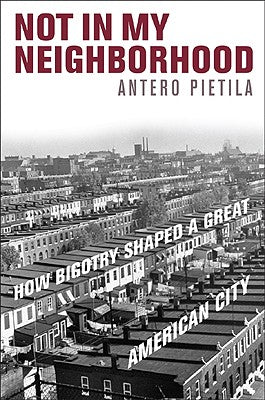
Eugenics, racial thinking, and white supremacist attitudes influenced even the federal government's actions toward housing in the 20th century, dooming American cities to ghettoization. The Federal Housing Administration continued discriminatory housing policies even into the 1960s, long after civil rights legislation. This all-American tale is told through the prism of Baltimore, from its early suburbanization in the 1880s to the consequences of white flight after World War II, and into the first decade of the twenty-first century. The events are real, and so are the heroes and villains. Mr. Pietila's narrative centers on the human side of residential real estate practices, whose discriminatory tools were the same everywhere: restrictive covenants, redlining, blockbusting, predatory lending.
About the Author
About the Author
Antero Pietila spent thirty-five years as a reporter with the Baltimore Sun, most of it covering the city's neighborhoods, politics, and government. A native of Finland, he became a student of racial change during his first visit to the United States in 1964. He lives in Baltimore.
Critical Reviews
Critical Reviews
...Spellbinding....The scope of Pietila's research over the past 130 years is dazzling--Jason Policastro "Baltimore Brew"
With its sensitive subject, this groundbreaking book is a monumental effort.....Pietila hooks readers with anecdotes and arresting details.--Diane Scharper "Baltimore Sun"
From suburbanization in the late 19th century to white flight after WWII and, more recently, the targeting of minorities with predatory sub-prime lending, the picture of Baltimore, once again, isn't pretty.--Steven Levingston "The Review of Higher Education"
Not in My Neighborhood offers a lively, informative portrayal of how real estated practices throughout the twentieth century contributed to the segregated cities we see today. In a brief epilogue, the author voices optimism that increasing demographic diversity in the United States will lead to a more integrated future.-- "Journal of Planning Education and Research" (1/1/2011 12:00:00 AM)
A sharply critical, exhaustively researched, and absolutely invaluable analysis, Not In My Neighborhood is the most important kind of history book-the history that must be studied so that its mistakes are not repeated (and so that solutions to difficult problems can be worked upon for the future)! Highly recommended.-- "Midwest Book Review"
Not In My Neighborhood: How Bigotry Shaped A Great American City offers a powerful survey of a Baltimore issue that shaped a city's psyche when discrimination policies toward blacks and Jews shaped a world....Eye-opening and recommended for any college-level social issues collection.-- "Midwest Book Review"
Antero Pietila's sweeping and detailed portrait of Baltimore's 20th-century blockbusters is a must-read for anyone who wants to understand how and why the city came to look the way it does today. Morris Goldseker, the mighty Jack Pollack, "Little Willie" Adams, James Rouse, Joseph Meyerhoff, and even civil rights legends such as Juanita Mitchell all played their part--and profited from--Baltimore's racially rigged housing business. Clearly written, fast-paced, and filled with telling anecdotes, Not in My Neighborhood brings these players to vivid life, even if it merely nods to some of the larger, more impersonal forces that gave them their opportunities.-- "Baltimore City Paper"
Former Baltimore Sun reporter Pietila, who covered Baltimore neighborhoods and politics for 35 years, has produced an engrossing chronicle that emphasizes the links between racism, real estate practices, and urban politics. Indeed, the author argues they have been inseparable in Baltimore--and the nation. Pietila suggests that federal housing programs (1930s-60s) transformed the eugenics movement into national policy, and he significantly places realtors and developers at the very center of Baltimore politics. Most of the narrative focuses on the period 1910-68, although the author traces racial and real estate patterns back to the 1880s. The third section covers the 1960s and early 1970s....White versus black racism and black and white anti-Semitism are the main themes here, but Pietila's...account reveals class and religion added to already complex tensions. For instance, some Jewish developers would not rent or sell to Jewish families. Newspapers and personal interviews provide some colorful details. Secondary scholarship connects the Baltimore example to the national struggle over access to decent housing, driven by optimism, fear, and sometimes violence. Summing Up: Recommended.-- "Choice Reviews"
Publishing Information
Publishing Information
Publisher:
Ivan R. Dee Publisher
Pub date:
2010-03-01
Length:
336 pages
The Allstora Membership
Membership Perks:
- Save 30% on all online store purchases
- Exclusive access to author's content
- You pay less, but authors still earn double
Membership Terms:
First Month:
$0.00
Monthly price:
$5.00
- To access membership discount simply log in and add to cart, discount applied automatically.
- One month free trial, cancel anytime. Membership renews on the 15th of each month.