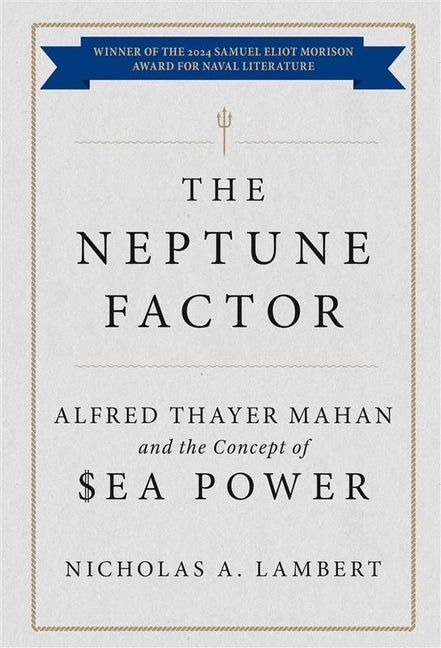
Neptune Factor: Alfred Thayer Mahan and the Concept of Sea Power


Neptune Factor: Alfred Thayer Mahan and the Concept of Sea Power
Neptune Factor: Alfred Thayer Mahan and the Concept of Sea Power
Description
Description
About the Author
About the Author
Nicholas Lambert is a naval historian and a leading authority on the strategic implications of globalization. He received his B.A. with a double major in economics and in history, his M.A. in history and economics, and his D.Phil. in modern history from Worcester College, University of Oxford. Afterwards, he held an Olin Fellowship at Yale University. In addition to The Neptune Factor: Alfred Thayer Mahan and the Concept of $ea Power (Naval Institute Press, 2023), he has written three other research monographs: Planning Armageddon: British Economic Warfare and the First World War (Harvard University Press, 2012), in which he pioneered the concept of weaponizing the infrastructure of the global trading system, and which was awarded the Norman B. Tomlinson Prize; The War Lords and the Gallipoli Disaster: How Globalized Trade Led Britain to its Worst Defeat of the First World War (Oxford University Press, 2021), which was awarded the John Lyman Prize; and Sir John Fisher's Naval Revolution (University of South Carolina Press, 1999), which received both the Norman B. Tomlinson Prize and the Society for Military History's Distinguished Book Award. He is also the author of twenty research articles in leading journals. His most recent commentary has appeared in Wall Street Journal and the Proceedings of the US Naval Institute.
Lambert resides outside Philadelphia with his family, having previously lived in Washington, DC, as well as India, Taiwan, and Australia. From 2016 to 2018, he held the 'Class of 1957 Distinguished Chair in Naval Heritage' at the US Naval Academy, and is privileged to be an honorary member of the Class of '57
Critical Reviews
Critical Reviews
"Lambert's method, as in all his work, is not to proceed from received wisdom about his subject, but to go back to the original sources. The result is a book that explains - far better than any account of Mahan known to me - why he is still read in Beijing today, and why he would repay closer reading in Washington. Lambert's Mahan is not the crude evangelist of decisive battle between battleships he is often caricatured as but a subtle and evolving thinker about the relationship between naval and economic power. Rejecting the notion that Mahan should be read for his contributions to some abstract naval theory, Lambert insists on the need to put him in his historical context -- which was dominated by massive economic change. Manifestly, Lambert's Mahan-in-full is more relevant to contemporary US national-security policy than the legendary Mahan obsessed with "kinetic" combat operations. No less important is Lambert's inspiration to young students of power today. His unequalled treatment of Mahan demonstrates many truths between the lines, and they resonate. As a historian, Lambert does not say what U.S. strategy should be. But The Neptune Factor offers ample food for thought for those who want American naval power to fulfill its true purpose - protecting and advancing the naturally unstable sovereignty of democracy, for both ourselves and those willing to partner in the effort."--Defense and Aerospace Report
"Your book is very important."--Cavas Ships Podcast "Revisionist and radical though it may seem, Lambert's work is surely one of the best books ever published by the Naval Institute Press. The Neptune Factor: Alfred Thayer Mahan and the Concept of Sea Power is a deeply researched, clearly argued, and thought-provoking history of Mahan and his writings. The book and its nearly 1,200 footnotes are reinforced by what Mahan read and his correspondence with leading experts of the day, along with Lambert's comprehensive critiques of prior Mahan interpretations, which have led the Navy to see its preeminent theorist as primarily focused on combat. Whether as applicable history or a detailed revision of prior interpretations, Neptune Factor succeeds. To appreciate Mahan and his theory of sea power in its fullest form is to read all he wrote, what he wrote to those with whom he corresponded, and what he read throughout his life's work. It is a lot of reading, and Nicholas Lambert did it. Now, we must too. Go read Neptune Factor."--Proceedings "Lambert shows how Mahan's thinking developed over time as the strategist came to stress the importance of blockades and destroying the enemy's commerce."--Foreign Affairs "Most naval officers and historians meet Alfred Thayer Mahan in college or professional military education courses on history and strategy. Although many do not actually read Mahan, they read synopses of his work that summarize Mahan as obsessed with large fleets, decisive battles, and "command of the sea." Nicholas A. Lambert, who has made a name for himself by researching the nexus of naval and economic history, challenges this perception of Mahan in The Neptune Factor. With this book, Lambert has written both a biography of Mahan and a review of his major works and many of his numerous articles. The book is well written and includes plenty of lengthy quotations that introduce Mahan's most important concepts. Lambert overturns years of historical denigration to show that Mahan was a well-respected seaman. This professional rehabilitation solidifies Mahan's bona fides as a naval professional. More than that, however, Lambert also shows Mahan to have been a superb historian. Lambert demolishes the myth that Mahan's theory of sea power was obsessed with battle fleets and decisive combat. Instead, Lambert shows that Mahan recognized that properly maintained navies secured the flow of trade, generating wealth and leading to national power. Historians and naval professionals would all benefit from reading The Neptune Factor, a tremendously readable and thought-provoking history that thoroughly rehabilitates Mahan's much-maligned strategic philosophy and professional reputation."--H-Net "Nicholas Lambert has written the most incisive assessment of Captain Alfred Thayer Mahan's thought on seapower that has appeared in many years. The Neptune Factor is an original and valuable reassessment of Mahan's theories on seapower. In contrast to many who have seen him solely as the herald of imperialism and of the need for a large battlefleet to support national colonial ambitions by winning command of the sea, Lambert convincingly demonstrates that Mahan, through his linkage of seapower and economics, was a far more original and complex strategic thinker. Aside from Mahan's books themselves, Lambert's work should be the first port of call for anyone seeking insight into the captain's thinking."--Capt. Jay T. Young, USN (Ret.) War Studies Journal "Nicholas Lambert's latest book is undoubtedly one of the most relevant works of the last five years in the subject of maritime strategic thinking. Despite being one of the most mentioned authors in this area of study, the American naval strategist Alfred Mahan (1840-1914) has always been much more quoted than read, and, therefore, writing about him and his work is never an easy task. As Lambert demonstrates, Mahan deserves less credit than he deserves on certain issues, but his work should not be read and understood superficially and without attention to the message -often hidden in the pompous and disorderly grammatical construction- that characterizes some of his works. Moreover, at a historical moment such as the present, when the world is entering a new era of struggle between great powers in which maritime power will be decisive, rereading Mahan with an open mind is once again an indispensable task. Especially for a U.S. maritime community that finds itself in dire straits as it tries to reverse the effects of three decades of barely looking at the sea through Mahan's eyes."--Global Affairs and Strategic Studies
Publishing Information
Publishing Information

The Allstora Membership
Membership Perks:
- Save 30% on all online store purchases
- Exclusive access to author's content
- You pay less, but authors still earn double
Membership Terms:
- To access membership discount simply log in and add to cart, discount applied automatically.
- One month free trial, cancel anytime. Membership renews on the 15th of each month.