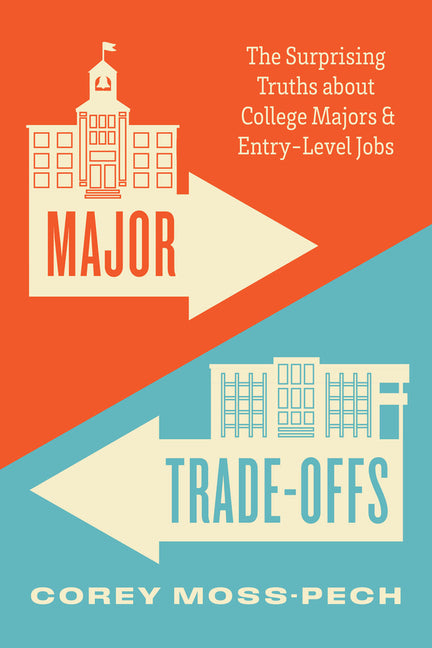
Major Trade-Offs: The Surprising Truths about College Majors and Entry-Level Jobs


Major Trade-Offs: The Surprising Truths about College Majors and Entry-Level Jobs
Major Trade-Offs: The Surprising Truths about College Majors and Entry-Level Jobs
Description
Description
An eye-opening look at the relationship between students' majors and their entry-level jobs. Humanities majors are used to answering the question, "So, what are you going to do with that degree?" The common misconception is that students in humanities programs don't learn any useful skills for the real world. In Major Trade-Offs, sociologist Corey Moss-Pech argues that not only do humanities majors learn real-world skills, but they actually use them when they graduate. Despite this discrepancy, graduates with so-called practical degrees like business and engineering are much more likely to find employment, and they earn higher salaries. Why do we belittle a liberal arts education despite the valuable skills that students acquire during their studies? Major Trade-Offs addresses this question by following students from different majors as they enter the workforce. To understand the relationship between majors and entry-level jobs, Moss-Pech conducted nearly 200 interviews with roughly ninety students from four majors at a large Midwestern university: engineering, business, English, and communications. He follows these students through their senior years, chronicling their internships and the support their universities provide in helping them pursue their career paths. He found that graduates from practical majors entered the labor market successfully, typically through structured internship programs. However, many ended up in entry-level jobs that, while well-paid, were largely clerical and didn't necessarily require a degree to perform. On the other hand, liberal arts majors rarely accessed structured internships and were largely left to carve out their own paths, but did use their degree skills once they secured a job. These results challenge popular myths about the "marketability" of these different majors and offer a new vision for the future of higher education. Liberal arts skills are essential in the labor market, and yet educators and policymakers still push resources into the practical arts, perpetuating the myth that those majors are more valuable while depriving students of a well-rounded education and leaving them no better prepared for the workforce than liberal arts students. Of interest to students, educators, and employers, Major Trade-Offs calls on colleges and universities to advocate for liberal arts majors, leveling the playing field for students as they plan for entry-level work.
About the Author
About the Author
Corey Moss-Pech is assistant professor of sociology at Florida State University.
Critical Reviews
Critical Reviews
"Folk wisdom tells students and parents that practical majors are the most secure pathway to a good job and a good life. Major Trade-Offs turns this thinking on its head, showing how recent graduates in the liberal arts are uniquely positioned to use what they have learned in their work. What is college for? And what kinds of jobs offer worthwhile work for college graduates? Corey Moss-Pech raises these important questions, giving us a rare glimpse into how college students are entering the workforce today, and what awaits them in their work."
--Natasha Quadlin, University of California, Los Angeles "Major Trade-Offs upends conventional wisdom about which college majors lead to job-relevant skills and raises critical questions about whether students really need practical majors to prepare for careers--or whether what they're really getting is access to a hiring pipeline. A real achievement."--Elizabeth Popp Berman, author of 'Thinking like an Economist: How Efficiency Replaced Equality in U.S. Public Policy' "Moss-Pech exposes the too-simplistic dichotomy dividing 'good' practical majors from 'bad' liberal arts training. Adding nuance to how we think about the links between education and early career occupations, this book should be read by anxious students and parents, recruiters and employers, and all campus leaders who prioritize STEM and pre-business programs over the humanities and social sciences."--Amy J. Binder, coauthor of "The Channels of Student Activism: How the Left and Right Are Winning (and Losing) in Campus Politics Today"
Publishing Information
Publishing Information
Publisher:
University of Chicago Press
Pub date:
2025-05-06
Length:
224 pages


The Allstora Membership
Membership Perks:
- Save 30% on all online store purchases
- Exclusive access to author's content
- You pay less, but authors still earn double
Membership Terms:
First Month:
$0.00
Monthly price:
$5.00
- To access membership discount simply log in and add to cart, discount applied automatically.
- One month free trial, cancel anytime. Membership renews on the 15th of each month.