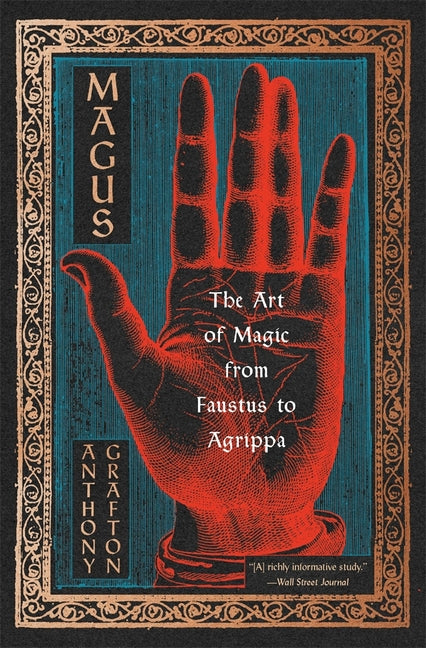
Magus: The Art of Magic from Faustus to Agrippa


Magus: The Art of Magic from Faustus to Agrippa
Magus: The Art of Magic from Faustus to Agrippa
Description
Description
A Seminary Co-op Notable Book
PROSE Award in European History
Critical Reviews
Critical Reviews
Sheds light on the golden age of occult writing...Magic could be made all-encompassing because language, belonging to a shared world view, allowed it to be...Grafton suggests that the mathematical and mechanical magic that allowed Agrippa and Dee to send artificial birds or insects flying over a stage set would develop into the science that produced the machinery of the Industrial Revolution.--Christopher Howse "The Telegraph" (12/17/2023 12:00:00 AM)
Grafton's magi are an appealing gang, inasmuch as they turn out to have occupied the liminal space between what was faith and what would become fact. The intellectual fabric that their investigations wove, as Grafton entertainingly relays, was an entanglement of absurd system and authentic discovery, of systematic fraud and startling originality, of obvious nonsense and pregnant novelty.--Adam Gopnik "New Yorker" (12/24/2023 12:00:00 AM)
Scholarly but marvellously readable...Not for nothing is Grafton renowned as today's leading historian of Renaissance intellectual culture...as erudite as it is enchanting.--Dmitri Levitin "Literary Review" (3/1/2024 12:00:00 AM)
[A] richly informative study.--William Tipper "Wall Street Journal" (2/9/2024 12:00:00 AM)
Through the principal magi of the high Renaissance, Grafton examines the often uneasy, sometimes beneficial, three-way relationship that existed between religion, magic and science.--Stephanie Merritt "The Guardian" (2/4/2024 12:00:00 AM)
An engaging collection of marvels.--Claire Fanger "Metascience" (9/5/2024 12:00:00 AM)
A brilliant reassessment of the magus and the role of magic in the philosophical and practical worlds of Renaissance Europe. Grafton's eloquent study profoundly expands our understanding of the range and intellectual context of thinkers such as Marsilio Ficino, Johannes Trithemius, and Heinrich Cornelius Agrippa. In the process, it deepens our understanding of an entire era.--Pamela O. Long, author of Engineering the Eternal City
Magus is a thought-provoking study of 'natural magic' and its early modern practitioners, the wandering European scholars who were at once praised as divinely inspired and denounced as diabolical charlatans. Carefully presenting these complex, elusive personalities on their own terms, Anthony Grafton's analysis of the magi is as closely woven as their schemes for calling down the powers that bind the universe.--Ingrid D. Rowland, author of From Pompeii
A new understanding of the Renaissance--and a new understanding of magic--springs to life in this erudite, witty, and eminently readable book.--Lauren Kassell, author of Medicine and Magic in Elizabethan London
A brilliantly vivid exercise in intellectual history, as told through the biographies of the early modern magi, which will stir the thoughts of everyone who reads it.--John Gray "New Statesman" (1/10/2024 12:00:00 AM)
Provides a chronicle of the development of magic from the infamous Dr. Faustus to the lesser-known but perhaps more influential Cornelius Agrippa, paying close attention to the lives of the various Early Modern magi as well as the historical milieu in which they functioned.--Jesse Russell "University Bookman" (2/23/2025 12:00:00 AM)
Magus offers a rich set of observations on an oft-neglected intellectual tradition during a turning point in Western thought...Magic is once again beginning to merit serious study in the academy.--Colin Dickey "Chronicle of Higher Education" (11/28/2023 12:00:00 AM)
A superb account of the astrologers, alchemists, and sorcerers who practiced 'natural magic' in Europe from the Middle Ages through early modernity...Grafton combines extensive research with a flair for the idiosyncrasies of biography, spinning charmingly digressive character portraits...The result will delight readers interested in the historical intersection of art, science, and religion.-- "Publishers Weekly (starred review)" (9/25/2023 12:00:00 AM)
Grafton brings clarity and verve to the study of Renaissance magicians, placing them in the motley company not only of humanists and Kabbalists, astrologers and necromancers, but also of cryptographers, forgers, and 'engineers.' He surveys a world peopled by striking individuals whose magical adventures and speculations are inseparable from the personalities that animated them.--Richard Kieckhefer, author of Magic in the Middle Ages
Publishing Information
Publishing Information
Publisher:
Belknap Press
Pub date:
2025-11-18
Length:
304 pages

The Allstora Membership
Membership Perks:
- Save 30% on all online store purchases
- Exclusive access to author's content
- You pay less, but authors still earn double
Membership Terms:
First Month:
$0.00
Monthly price:
$5.00
- To access membership discount simply log in and add to cart, discount applied automatically.
- One month free trial, cancel anytime. Membership renews on the 15th of each month.