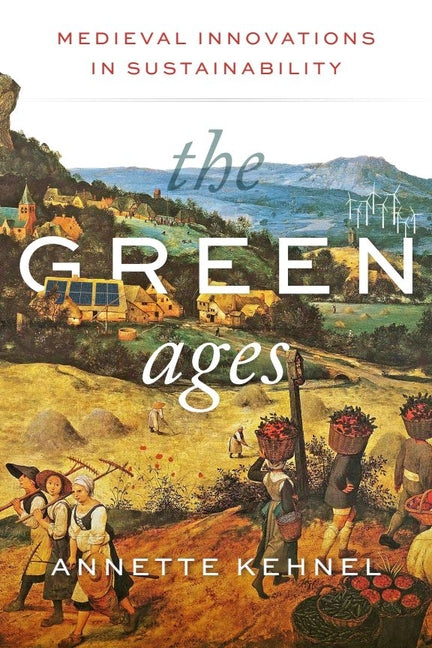
Green Ages: Medieval Innovations in Sustainability


Green Ages: Medieval Innovations in Sustainability
Green Ages: Medieval Innovations in Sustainability
About the Author
About the Author
Annette Kehnel is the chair of medieval history at the University of Mannheim in Germany. She has published numerous works on cultural and economic history and historical anthropology.
Critical Reviews
Critical Reviews
"Bold and exciting--a must-read! Kehnel offers surprisingly practical examples and introduces remarkable individuals from the last two thousand years." -- "Lyndal Roper, Oriel College, Oxford University"
"Finally, a historically enlightening approach to the sustainability debate. A wonderful and much needed book."-- "Harald Welzer, author and editor, futurzwei magazine"
"A committed and thought-provoking book, rich in engaging examples and surprising alternatives, that makes it clear we need the past for our future."-- "Bernd Schneidmüller, Heidelberg University"
"We don't need or want to relive the past--but we do need to mine it for ideas and practices that can help solve some of the dilemmas of the present. This fascinating book does just that--and in the process represents the zenith of recycling!"--Bill McKibben, author of The End of Nature
"Erudite and engaging, The Green Ages presents a powerful critique of the ideologies of the 'modern age' by historicizing their guiding image of the human as the self-interested Homo economicus. Excavating times when sharing, recycling, cooperation, and frugality were some of the reigning values in Europe, Kehnel makes a point crucial to any imagination of change: another world is possible. An important book for all students of sustainable futures."--Dipesh Chakrabarty, author of One Planet, Many Worlds
"Bold, imaginative, and vividly written, here finally is a historical survival guide in our climate crisis that reminds us that it is possible to live differently and sustainably."--Frank Trentmann, author of Empire of Things
"A clarion call from the past to guide us through a troubled future. . . . Kehnel's The Green Ages is a book written from the heart but with a head fully versed in medieval economic life and theory and as such it is a fervent cry to reconsider capitalism assumptions as to how the world should be run and to consider instead how to live more harmoniously and in partnership both with each other, with the seasons and the rhythm of the natural world. There is, Kehnel shows, much to learn from the past and if we want a sustainable future that is where we should first look."--Henrietta Leyser, author of Medieval Women
"The Green Ages takes the reader through a fascinating journey over several hundred years of history to prove beyond doubt that a different kind of world really is possible. The book shows that human beings are as capable of cooperation and mutualism as they are of competition and individualism--and that reconnecting with these basic human instincts is the key to our survival."--Grace Blakeley, author of Vulture Capitalism
"With The Green Ages, (Kehnel) has written a book of great joy: an environmental history of many facets, which explains how some premodern practices of sustainability are applicable to the present day." -- "The Telegraph"
"A lively study (which) demonstrates that historically people have changed their way of life when called on. More narratives like this are needed." -- "Library Journal"
"Energetically argued and traversing fresh lines of research traditionally ignored in histories of the time period, the book offers some sorely needed examples of historical sustainability for a self-complacent world content in careening towards ecological blight, and does so by borrowing light from the denizens of an age thought lost in darkness."-- "Open Letters Review"
"(A) wide-ranging and highly accessible polemic on medieval sustainability." -- "Times Literary Supplement"
"Many of the case studies Kehnel puts forward are attractively described, and it is refreshing to see such a positive argument about what can be learned from premodern ways of living." -- "History Today"
"[Kehnel's] book is a great success in reminding of us just how rich and varied the lives of our forebears were, and thus, as she points out, how varied those of our successors could be."-- "Church Times"
"This book is a passionate, honest, and stimulating critique of the current metanarrative of progress, growth, and wealth, which the author argues arrived with the Industrial Revolution and resulted in short-term thinking and unsustainable lifestyles. . . . The scholarship is solid and carefully footnoted."-- "Choice"
Publishing Information
Publishing Information
Publisher:
Brandeis University Press
Pub date:
2024-09-26
Length:
352 pages
The Allstora Membership
Membership Perks:
- Save 30% on all online store purchases
- Exclusive access to author's content
- You pay less, but authors still earn double
Membership Terms:
First Month:
$0.00
Monthly price:
$5.00
- To access membership discount simply log in and add to cart, discount applied automatically.
- One month free trial, cancel anytime. Membership renews on the 15th of each month.