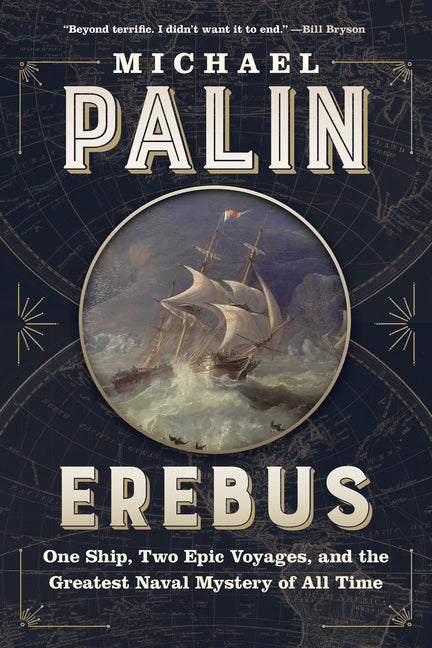
Erebus: One Ship, Two Epic Voyages, and the Greatest Naval Mystery of All Time


Erebus: One Ship, Two Epic Voyages, and the Greatest Naval Mystery of All Time
Erebus: One Ship, Two Epic Voyages, and the Greatest Naval Mystery of All Time
Description
Description
Intrepid voyager, writer and comedian Michael Palin follows the trail of two expeditions made by the Royal Navy's HMS Erebus to opposite ends of the globe, reliving the voyages and investigating the ship itself, lost on the final Franklin expedition and discovered with the help of Inuit knowledge in 2014. The story of a ship begins after the defeat of Napoleon at Waterloo, when Great Britain had more bomb ships than it had enemies. The solid, reinforced hulls of HMS Erebus, and another bomb ship, HMS Terror, made them suitable for discovering what lay at the coldest ends of the earth.
In 1839, Erebus was chosen as the flagship of an expedition to penetrate south to explore Antarctica. Under the leadership of the charismatic James Clark Ross, she and HMS Terror sailed further south than anyone had been before. But Antarctica never captured the national imagination; what the British navy needed now was confirmation of its superiority by making the discovery, once and for all, of a route through the North-West Passage.
Chosen to lead the mission was Sir John Franklin, at 59 someone many considered too old for such a hazardous journey. Nevertheless, he and his men confidently sailed away down the Thames in April 1845. Provisioned for three winters in the Arctic, Erebus and Terror and the 129 men of the Franklin expedition were seen heading west by two whalers in late July.
No one ever saw them again.
Over the years there were many attempts to discover what might have happened--and eventually the first bodies were discovered in shallow graves, confirming that it had been the dreadful fate of the explorers to die of hunger and scurvy as they abandoned the ships in the ice.
For generations, the mystery of what had happened to the ships endured. Then, on September 9th, 2014, came the almost unbelievable news: HMS Erebus had been discovered thirty feet below the Arctic waters, by a Parks Canada exploration ship.
Palin looks at the Erebus story through the different motives of the two expeditions, one scientific and successful, the other nationalistic and disastrous. He examines the past by means of the extensive historical record and travels in the present day to those places where there is still an echo of Erebus herself, from the dockyard where she was built, to Tasmania where the Antarctic voyage began and the Falkland Islands, then on to the Canadian Arctic, to get a sense of what the conditions must have been like for the starving, stumbling sailors as they abandoned their ships to the ice. And of course the story has a future. It lies ten metres down in the waters of Nunavut's Queen Maud Gulf, where many secrets wait to be revealed.
In 1839, Erebus was chosen as the flagship of an expedition to penetrate south to explore Antarctica. Under the leadership of the charismatic James Clark Ross, she and HMS Terror sailed further south than anyone had been before. But Antarctica never captured the national imagination; what the British navy needed now was confirmation of its superiority by making the discovery, once and for all, of a route through the North-West Passage.
Chosen to lead the mission was Sir John Franklin, at 59 someone many considered too old for such a hazardous journey. Nevertheless, he and his men confidently sailed away down the Thames in April 1845. Provisioned for three winters in the Arctic, Erebus and Terror and the 129 men of the Franklin expedition were seen heading west by two whalers in late July.
No one ever saw them again.
Over the years there were many attempts to discover what might have happened--and eventually the first bodies were discovered in shallow graves, confirming that it had been the dreadful fate of the explorers to die of hunger and scurvy as they abandoned the ships in the ice.
For generations, the mystery of what had happened to the ships endured. Then, on September 9th, 2014, came the almost unbelievable news: HMS Erebus had been discovered thirty feet below the Arctic waters, by a Parks Canada exploration ship.
Palin looks at the Erebus story through the different motives of the two expeditions, one scientific and successful, the other nationalistic and disastrous. He examines the past by means of the extensive historical record and travels in the present day to those places where there is still an echo of Erebus herself, from the dockyard where she was built, to Tasmania where the Antarctic voyage began and the Falkland Islands, then on to the Canadian Arctic, to get a sense of what the conditions must have been like for the starving, stumbling sailors as they abandoned their ships to the ice. And of course the story has a future. It lies ten metres down in the waters of Nunavut's Queen Maud Gulf, where many secrets wait to be revealed.
About the Author
About the Author
Michael Palin has written and starred in numerous television programs and films, from Monty Python to A Fish Called Wanda. He is also an acclaimed author, documentary filmmaker, and explorer. A former president of the Royal Geographical Society, his journeys have taken him to the North and South Poles, the Sahara Desert, the Himalayas, and Brazil. He lives in London, England.
Critical Reviews
Critical Reviews
"Beyond terrific. I didn't want it to end."
--Bill Bryson
"Cracking good reading"
--Publishers Weekly
"Carefully researched and well-crafted... brings the story of a ship vividly to life"
--The Times
"Palin's account is full of wit and sympathy"
--The Guardian
"A considerable scholarly and storytelling achievement"
--Post Magazine
"Palin seeks to celebrate the spirit of exploration that set Erebus on her course [and] how such overweening self-confidence left the wreck of a fine ship disintegrating on the bed of the freezing Arctic Ocean."
--Financial Times
"A well-written and captivating examination of the Erebus' adventures"
--Washington Times
"Using Erebus as a structure for outlining British Polar exploration in the first half of the nineteenth century ... is a wonderful idea and few could have carried it out as well as Michael Palin."
--The Arctic Book Review
"With this irresistible and often harrowing account, Michael Palin makes a convincing case that one heroic little ship embodied the golden age of polar exploration better than any other: HMS Erebus."
--John Geiger, co-author of Frozen in Time: The Fate of the Franklin Expedition
"At this late date, and against all odds, Michael Palin has found an original way to enter and explore the Royal Navy narrative of polar exploration. Palin is a superb stylist, low-key and conversational, who skillfully incorporates personal experience. He turns up obscure facts, reanimates essential moments, and never shies away from taking controversial positions. This beautifully produced volume--colour plates, outstanding maps--is a landmark achievement."
--Ken McGoogan, author of Dead Reckoning: The Untold Story of the Northwest Passage
"Expertly written and masterfully crafted, Palin's story of one ship's two bold explorations successfully weaves together two hundred years of history into page-turning entertainment."
--Adam Shoalts, author of Alone Against the North: An Expedition into the Unknown
"Michael Palin is a cracking good companion on this journey of ambition, longing, triumph and tragedy. His dauntless curiosity drives us through ice-infested waters from pole to pole, and his passion for weaving together the lives of the men who lived and died on Erebus infuses every page. More than that, though, Palin's contagious spirit of exploration proves that the age of adventure lives on in us still."
--Alanna Mitchell, author of The Spinning Magnet: The Force that Created the Modern World and Could Destroy It
"One robust little tub of a boat, two death-defying voyages to the ends of the earth. Palin has given us a fascinating account of the extraordinary courage of nineteenth-century British sailors and officers. Even the sturdiest vessel is dependent on luck, climate and its captain's skills as he faces ferocious weather, and Palin illuminates with enthusiasm and respect this chilly history of a bomb ship that made its name first as a polar pioneer and then later as a watery tomb. Enthralling."
--Charlotte Gray, author of Gold Diggers: Striking It Rich
"What more could a reader ask for? Fascinating mystery, chilling adventure, compelling characters--one a powerful woman, another made of wood and sails--and simply terrific writing by Michael Palin."
--Roy MacGregor, author of Original Highways: Travelling the Great Rivers of Canada
Publishing Information
Publishing Information
Publisher:
Greystone Books
Pub date:
2019-10-08
Length:
352 pages

The Allstora Membership
Membership Perks:
- Save 30% on all online store purchases
- Exclusive access to author's content
- You pay less, but authors still earn double
Membership Terms:
First Month:
$0.00
Monthly price:
$5.00
- To access membership discount simply log in and add to cart, discount applied automatically.
- One month free trial, cancel anytime. Membership renews on the 15th of each month.