Dreaming in Ensemble: How Black Artists Transformed American Opera


Dreaming in Ensemble: How Black Artists Transformed American Opera
Dreaming in Ensemble: How Black Artists Transformed American Opera
Description
Description
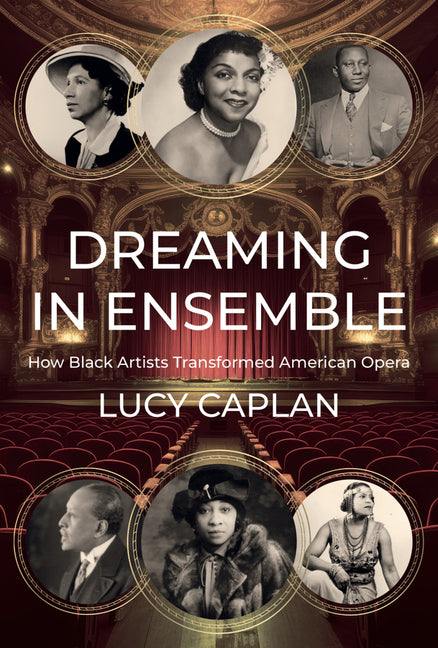
A revelatory new account of Black innovation in American opera, showing how composers, performers, and critics redefined the genre both aesthetically and politically in the early twentieth century.
The inauguration of a "golden age" in Black opera is often dated to 1955, when Marian Anderson became the first Black singer to perform in a leading role at New York's Metropolitan Opera. Yet Anderson's debut was actually preceded by a rich Black operatic tradition that developed in the first half of the twentieth century. Lucy Caplan tells the stories of the Black composers, performers, critics, teachers, and students who created this vibrant opera culture, even as they were excluded from the genre's most prominent institutions. Their movement, which flourished alongside the Harlem Renaissance, redefined opera as a wellspring of aesthetic innovation, sociality, and antiracist activism. Caplan argues that Black opera in the early twentieth century had decidedly countercultural ambitions. In opera's sonic grandeur and dramatic maximalism, artists found creative resources for expressing the complexity of Black life. The protagonists of this story include composers Harry Lawrence Freeman and Shirley Graham, whose operas boldly interpreted Black diasporic history; performers Caterina Jarboro and Florence Cole-Talbert, who both starred in the racially fraught role of Aida; and critics Sylvester Russell and Nora Holt, who wrote imaginatively about the genre in the Black press. Yet Caplan also focuses on the many Black students, amateurs, opera house staff, and listeners who contributed indelibly to opera's meanings. With the creation of new companies, choruses, and audiences, opera not only circulated in the Black public sphere but itself became a public sphere with radical potential.
Critical Reviews
Critical Reviews
I am banging my fists on the table, shouting at you to read Lucy Caplan's extraordinary book. Meticulously researched and beautifully written, this book has achieved that rare feat of advancing our conversations on Blackness and classical music by decades. It is a work of field-defining scholarship.--Kira Thurman, author of Singing Like Germans: Black Musicians in the Land of Bach, Beethoven, and Brahms
Get in the crowd with Lucy Caplan. In this brilliant book, Caplan excavates the remarkable history of a vibrant, bustling, furiously creative array of cultural and social actors, African Americans who embraced opera not only to experiment with aesthetics but also to theorize Black life, Black politics, the Black historical past, and Black futures. That they so often executed this ambitious work as an inspired form of collaboration--rather than as a solitary endeavor--is just one of the many revelations in this luminous study of a history hidden in plain sight.--Daphne A. Brooks, author of Liner Notes for the Revolution
Opera's death knell has been ringing for decades, and artists like myself have toiled with how or if to save it. Lucy Caplan's fervent investigation unearths and honors opera's excluded Black cultural history in a way that illuminates a path to how opera can and should exist today.--Davóne Tines, Grammy Award-nominated classical singer
A moving and critical book, researched and narrated with great care. Caplan's storytelling welcomes any reader interested in unabridged accounts of music history, and honors individuals who enriched the art form of opera but often were discredited or discounted. The act of liberating oneself through one's voice is as intrinsic to opera as it is to the legacy of B/black diasporic people. As a musician who has often felt frustrated when seeking information on and inspiration in the complexities of the American musical landscape, I am so grateful to now have this book documenting our precious, radical history.--Julia Bullock, Grammy Award-winning classical singer
Lucy Caplan's fantastic new study illuminates a revolutionary and vibrant artistic community. Joining individual aspirations and institutional grit, Black artists dramatically influenced operatic traditions in the United States, where the opera house itself became a site of struggle and transformation. As Caplan shows, bel canto singing by Black performers and arias sketched by sepia hands were countercultural acts brimming with liberatory fantasies that rode on every high C. This book is operatic!--Guthrie P. Ramsey Jr., author of Race Music: Black Cultures from Bebop to Hip-Hop
An ambitious, demanding work on neglected Black artists.-- "Kirkus Reviews" (11/9/2024 12:00:00 AM)
Caplan highlights a treasure trove of vocalists and creators in this magisterial work that will prove immensely rewarding to serious opera scholars and those studying race relations and sociology in the 20th-century United States.--Barry Zaslow "Library Journal" (12/1/2024 12:00:00 AM)
A significant contribution to the histories of American opera, the performing arts, and Black American culture...will enlighten and inform opera fans and readers interested in Black artists and culture.--Carolyn Mulac "Booklist" (1/1/2025 12:00:00 AM)
Fascinating...a many-sided portrait of...a 'Black operatic counterculture.'--Ralph P. Locke "Arts Fuse" (3/1/2025 12:00:00 AM)
Publishing Information
Publishing Information
Publisher:
Harvard University Press
Pub date:
2025-02-04
Length:
336 pages
The Allstora Membership
Membership Perks:
- Save 30% on all online store purchases
- Exclusive access to author's content
- You pay less, but authors still earn double
Membership Terms:
First Month:
$0.00
Monthly price:
$5.00
- To access membership discount simply log in and add to cart, discount applied automatically.
- One month free trial, cancel anytime. Membership renews on the 15th of each month.