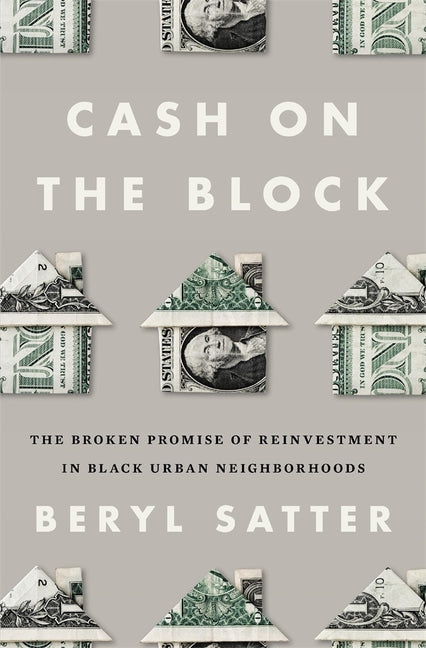
Cash on the Block: The Broken Promise of Reinvestment in Black Urban Neighborhoods


Cash on the Block: The Broken Promise of Reinvestment in Black Urban Neighborhoods
Cash on the Block: The Broken Promise of Reinvestment in Black Urban Neighborhoods
Description
Description
An incisive history of government and corporate failures to infuse capital into Black urban neighborhoods--as well as the organizers and activists who stood up to predatory financial practices.
In the 1960s, conditions in impoverished Black neighborhoods attracted mainstream attention as civil unrest erupted in hundreds of cities across the United States. Finally recognizing the dire effects of racial segregation and urban disinvestment, politicians and corporations joined community activists to call for capital infusion, or reinvestment, in struggling communities. Proposals for reinvestment universally claimed the shared goal of reviving Black neighborhoods, but most of these efforts--some well-meaning, others cynical and predatory--failed to do so. As renowned historian Beryl Satter shows, private and government interests have long manipulated reinvestment programs to benefit outside business, finance, and real estate professionals. Because these programs focused on corporate tax breaks and federal insurance for lenders, they were easily exploited by private interests to divert funding from poor urban neighborhoods. Meanwhile, community organizers proposed much bolder reinvestment plans that directly confronted institutionally racist practices. They called for a significant reallocation of resources, including government investments in depleted areas and guaranteed incomes for poor people. Activists, often working-class women, also united across racial divides to challenge predatory finance and real estate practices. Yet while they successfully advocated for laws to impede such behaviors, reform legislation often contained loopholes that accommodated racism and corporate greed. To revive impoverished neighborhoods, we must not only challenge institutional racism in finance and real estate but also resist government policies that enable predatory practices. Cash on the Block envisions a future in which reinvestment policy, guided by community leaders, at last benefits those it is meant to serve.
Critical Reviews
Critical Reviews
A devastating and revelatory history of institutional racism in America. Balancing incisive analysis with her gift for storytelling, Beryl Satter boldly recounts how self-serving government and corporate programs have perpetuated Black disadvantage and deepened inequality in the past--and how they continue to do so today. This is a history that shatters myths, speaks fearlessly to the urgent concerns of the present, and provides the clarity that we need to find a new way forward.--Andrew W. Kahrl, author of The Black Tax: 150 Years of Theft, Exploitation, and Dispossession in America
What happens when government outsources the revival of impoverished neighborhoods to private profit-seeking lenders? Predation, plunder, and extraction of wealth from already struggling families, as Beryl Satter shows in this searing, wise, and haunting history. Just as importantly, Satter explains how the savvier reinvestment strategy first proposed by Black thinkers and then elaborated by interracial community organizers in the 1970s could still work in our time--with greater power and stronger political will.--Nancy MacLean, author of Democracy in Chains: The Deep History of the Radical Right's Stealth Plan for America
Beryl Satter, author of the acclaimed book Family Properties, does it again. Cash on the Block is a masterpiece that, for decades to come, will be essential reading for scholars, policymakers, and anyone who wants to understand the economic exploitation of Black Americans. With extraordinary archival depth and analytic clarity, Satter reveals how ostensibly race-neutral laws, financial instruments, and bureaucratic incentives systematically extracted wealth from Black urban communities. The result is one of the most incisive accounts of why reinvestment efforts have repeatedly failed--and what genuine equity would require.--Bernadette Atuahene, author of Plundered: How Racist Policies Undermine Black Homeownership in America
A riveting read and a compelling account of how public-private partnerships have led to the divestment of wealth from Black urban neighborhoods. Masterfully weaving together the political philosophies of Martin Luther King Jr., Stokely Carmichael, and Charles V. Hamilton, Beryl Satter highlights the significance of Black activists and community organizers in solving today's most intractable problems.--Dorothy A. Brown, author of The Whiteness of Wealth: How the Tax System Impoverishes Black Americans--and How We Can Fix It
Publishing Information
Publishing Information
Publisher:
Harvard University Press
Pub date:
2026-05-12
Length:
416 pages

The Allstora Membership
Membership Perks:
- Save 30% on all online store purchases
- Exclusive access to author's content
- You pay less, but authors still earn double
Membership Terms:
First Month:
$0.00
Monthly price:
$5.00
- To access membership discount simply log in and add to cart, discount applied automatically.
- One month free trial, cancel anytime. Membership renews on the 15th of each month.