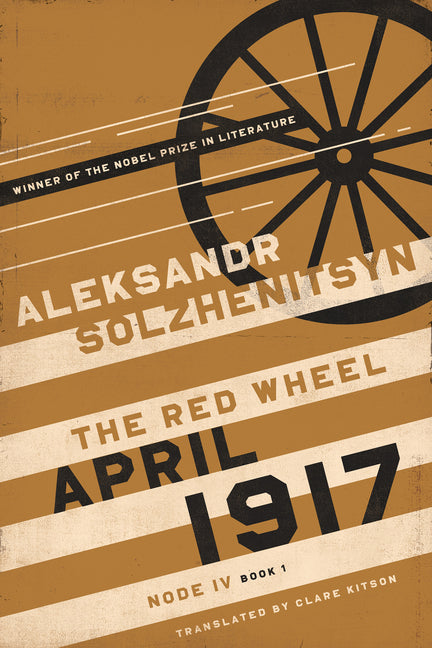
April 1917: The Red Wheel, Node IV, Book 1


April 1917: The Red Wheel, Node IV, Book 1
April 1917: The Red Wheel, Node IV, Book 1
Description
Description
April 1917, Book 1, captures the division and helplessness of Russia's first Revolutionary rulers, paving the way for the victory of the ruthless Bolsheviks later that year.
One of the masterpieces of world literature, The Red Wheel is Nobel prize-winner Aleksandr Solzhenitsyn's multivolume epic work about the Russian Revolution told in the form of a historical novel. April 1917--the fourth node--shows the intractable divisions that would lead Russia to catastrophic Communist dictatorship and civil war. Whereas the first three nodes of The Red Wheel form its first act, "The Revolution," April 1917 opens its second act, "The Rule of the People."
The action of Book 1 (of two) is set during April 11-May 5, 1917. Book 1 presents an early showdown, just seven weeks into the revolution, between its various wings. The Provisional Government comes under fire for its "bourgeois" capitalism and continuing commitment to World War I. Bolshevik leader Vladimir Lenin returns from exile and delivers his April Theses in Petrograd, actively sowing seeds of division. He declares that the revolution is not complete and openly calls for civil war, outlining a radical plan to overthrow the Provisional Government and seize power for the Soviets. Amid the chaos and rising tide of Bolshevism, the elements of resistance, and decency, slowly begin to awaken.
About the Author
About the Author
Aleksandr Solzhenitsyn (1918-2008), Nobel Prize laureate in literature, was a Soviet political prisoner from 1945 to 1953. His story One Day in the Life of Ivan Denisovich (1962) made him famous, and The Gulag Archipelago (1973) further unmasked Communism and played a critical role in its eventual defeat. Solzhenitsyn was exiled to the West in 1974. He ultimately published dozens of plays, poems, novels, and works of history, nonfiction, and memoir, including In the First Circle, Cancer Ward, The Red Wheel epic, The Oak and the Calf, and Between Two Millstones.
Clare Kitson is a Russian literary translator. She is co-translator of Aleksandr Solzhenitsyn's memoir, Between Two Millstones, Book 2.
Critical Reviews
Critical Reviews
"I thoroughly enjoyed this book...both Solzhenitsyn and Kitson, the translator, bring life and eagerness to what could too easily become a dry rendering of history. Instead, it feels alive and vibrant, and has woken my historical interest further." --San Francisco Book Review
"Solzhenitsyn doesn't try to simplify the situation and its many actors into an easy narrative. . . . April 1917 . . . will reward longtime readers with his perspective on the inevitable failure of revolutions to produce utopia." --Shepherd Express
"The Red Wheel and The Gulag Archipelago have been called Solzhenitsyn's two 'cathedrals.' You cannot fully understand the horrors of communism and the history of the 20th century without reading them." --New York Journal of Books
"[A] magisterial depiction of the long, slow collapse of the Tsarist regime in which everybody gets a voice, but nobody feels that he or she can prevent the worst of it. Eerily prescient for the binary confusions of the present." --VoegelinView
"If Aleksandr Solzhenitsyn's The Gulag Archipelago presented a mindset-changing view of the history of the USSR, the historical novels that make up his epopee The Red Wheel are a counterweight to the heroics of the October Revolution." --The Russian Review
"Despite its relentless focus on political events, The Red Wheel paradoxically instructs that politics is not the most important thing in life. To the contrary, the main cause of political horror is the overvaluing of politics itself. It is supremely dangerous to presume that if only the right social system could be established, life's fundamental problems would be resolved. Like the great realist novelists of the nineteenth century, Solzhenitsyn believed that." --The New York Review of Books
"Having spent countless hours in the archives, Solzhenitsyn traced the sequence of events, day by day and sometimes hour by hour, with meticulous accuracy. Then what makes this book a work of literature? . . . Solzhenitsyn used his skill as a novelist primarily by relating events from the perspective of one or another historical character. . . . Along with the character's voice, we hear the author's often ironic commentary, and so register two points of view at once." --Law & Liberty
"With the publication of the first book of April 1917, we have arrived at the fourth and final 'node' of Solzhenitsyn's literary and historical masterwork The Red Wheel. . . . The writing is lively and vivid, and the author conveys vital moral and political truths through the narrative itself. . . . Solzhenitsyn's sympathies are clearly with the forces of 'resistance, and decency.'" --The New Criterion
Publishing Information
Publishing Information

The Allstora Membership
Membership Perks:
- Save 30% on all online store purchases
- Exclusive access to author's content
- You pay less, but authors still earn double
Membership Terms:
- To access membership discount simply log in and add to cart, discount applied automatically.
- One month free trial, cancel anytime. Membership renews on the 15th of each month.