Zero! the Number That Almost Wasn't


Zero! the Number That Almost Wasn't
Zero! the Number That Almost Wasn't
Description
Description
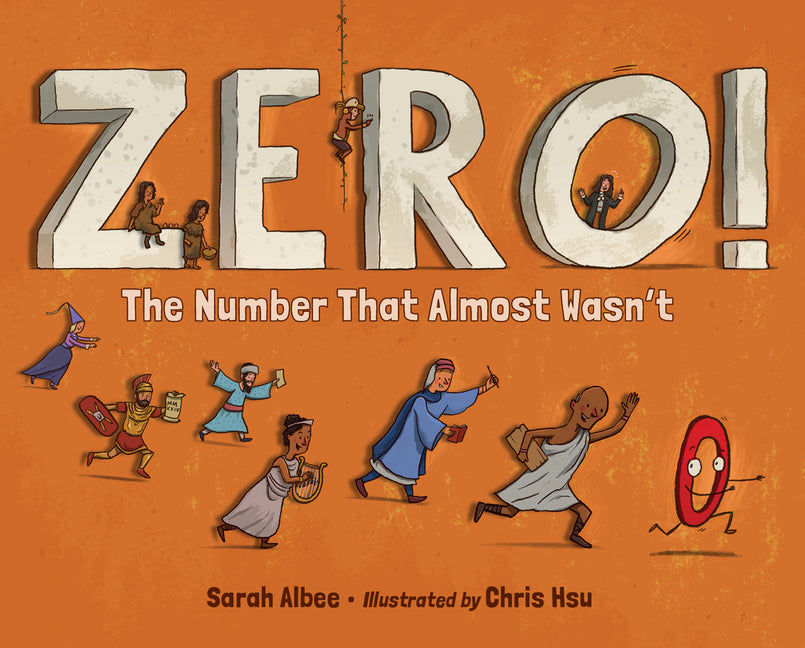
How did math work before zero existed? A STEM nonfiction book that unpacks a fascinating history of a number we can't imagine our current world without. From place value to being created and destroyed before being created again, zero has had quite a journey. Respected children's author and consummate researcher Sarah Albee lays out the history of zero alongside the complications that initially hampered its development, including Western imperialism. A riveting nonfiction kids book with a playful feel, Zero! unravels a complicated history in tremendous detail.
About the Author
About the Author
Sarah Albee is the New York Times bestselling author of more than 100 books for kids, including Troublemakers in Trousers and Accidental Archaeologists: True Stories of Unexpected Discoveries. Prior to being a full-time writer, Sarah worked at Children's Television Workshop (producers of Sesame Street) for nine years. She played basketball in college, and then a year of semiprofessional women's basketball in Cairo, Egypt. She lives in Brooklyn, New York. Born in Taipei, Taiwan and raised in Jacksonville, Florida, Chris Hsu is incessantly inquisitive about and heavily influenced by history, art history, science, classical music, psychology, and sports. In addition to book illustration he is an animation background artist, having worked on animated series such as Archer and Hit-Monkey. He is based in the Southeast with his wife and two daughters. He is the illustrator of I Am Someone Else, The Boo-Boos That Changed the World, and Madame Speaker.
Critical Reviews
Critical Reviews
♦ This cheerful picture book tells the story of how it took thousands of years for humans to realize that something was missing: a zero! It explains why it was so difficult to imagine something that actually meant nothing and documents how this emerging concept of nothingness fared in various civilizations around the world, taking several centuries to finally catch on. From the ancient Babylonians, the first to assign place values and realize that they needed a symbol showing nothing in this position, to Brahmagupta, a mathematician from India who wrote in Sanskrit to explain the significance of the numbers zero through nine, the plot follows the development of increasingly more complex math applications, from algebra (Persia) to calculating (Fibonacci) to calculus (Isaac Newton and Gottfried Wilhelm Leibniz). The book mentions initial European resistance, including how a few Christian leaders actually banished zero, until the invention of the printing press helped spread the concept and led to innovations in physics, engineering, electronics, and computers. Appealing digital drawings and rich back matter (uses of zero in everyday language, definitions, a time line, references, a bibliography, and a key to historical clues found in the illustrations) help round out this unique and attractive STEM offering.
--Booklist, starred review Everyone understands what it means to have nothing, but readers may be surprised to discover that zero as a mathematical concept is fairly recent. Albee charts the development of this revolutionary concept from the Babylonian introduction of placeholders to zero's influence on calculus and modern fields of knowledge from physics to computer science. An important aspect of the narrative is the fundamental contributions of nonwestern cultures such as the Mayan and Arabic cultures. Abee also shares roadblocks to the zero's acceptance, such as European Christian leaders who banished it, arguing that something that represented nothing must be "the work of the devil." Hsu's playful illustrations feature a cartoon personification of zero who not only observes its development, but sometimes takes an active role, such as standing next to the great Persian mathematician Al-Khwarizimi as he introduces the concept to fellow Persians. Back matter includes information about other words for zero, number systems, and the terminology; a brief bibliography; detailed timeline; and some fun notes on the illustrations. This is an excellent addition to books on math history and concepts.
--Children's Literature
--Booklist, starred review Everyone understands what it means to have nothing, but readers may be surprised to discover that zero as a mathematical concept is fairly recent. Albee charts the development of this revolutionary concept from the Babylonian introduction of placeholders to zero's influence on calculus and modern fields of knowledge from physics to computer science. An important aspect of the narrative is the fundamental contributions of nonwestern cultures such as the Mayan and Arabic cultures. Abee also shares roadblocks to the zero's acceptance, such as European Christian leaders who banished it, arguing that something that represented nothing must be "the work of the devil." Hsu's playful illustrations feature a cartoon personification of zero who not only observes its development, but sometimes takes an active role, such as standing next to the great Persian mathematician Al-Khwarizimi as he introduces the concept to fellow Persians. Back matter includes information about other words for zero, number systems, and the terminology; a brief bibliography; detailed timeline; and some fun notes on the illustrations. This is an excellent addition to books on math history and concepts.
--Children's Literature
Publishing Information
Publishing Information
Publisher:
Charlesbridge Publishing
Pub date:
2025-03-11
Length:
40 pages
The Allstora Membership
Membership Perks:
- Save 30% on all online store purchases
- Exclusive access to author's content
- You pay less, but authors still earn double
Membership Terms:
First Month:
$0.00
Monthly price:
$5.00
- To access membership discount simply log in and add to cart, discount applied automatically.
- One month free trial, cancel anytime. Membership renews on the 15th of each month.