Whiskerology: The Culture of Hair in Nineteenth-Century America


Whiskerology: The Culture of Hair in Nineteenth-Century America
Whiskerology: The Culture of Hair in Nineteenth-Century America
Description
Description
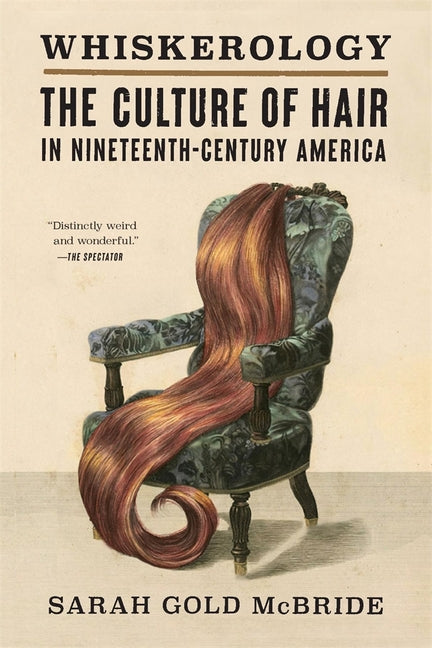
A surprising history of human hair in nineteenth-century America, where length, texture, color, and coiffure became powerful indicators of race, gender, and national belonging.
Hair is always and everywhere freighted with meaning. In nineteenth-century America, however, hair took on new significance as the young nation wrestled with its identity. During the colonial period, hair was usually seen as bodily discharge, even "excrement." But as Sarah Gold McBride shows, hair gradually came to be understood as an integral part of the body, capable of exposing truths about the individuals from whom it grew. As the United States diversified--and divisions over race, class, and citizenship status intensified--Americans sought to understand one another through the revelatory power of hair. Hair's biological properties came to be seen as a reliable indicator of whether a person was a man or a woman; Black, white, Indigenous, or Asian; Christian or heathen; healthy or diseased. Hair was even thought to illuminate aspects of personality--whether one was courageous, ambitious, or criminally inclined. Yet hair was also readily turned to purposes of deception in ways that empowered some and alarmed others. Indeed, hair helped many Americans to fashion statements about political belonging, to engage in racial or gender passing, and to reinvent themselves in new cities. A history inscribed in bangs, curls, and chops, Whiskerology illuminates the emergence of hair as an enduring and deeply fraught index of American belonging.
Critical Reviews
Critical Reviews
Goes beyond a mere cataloging of the appearances of hair in historical and cultural discourse to offer a persuasive demonstration of the intersectional significance of the materiality of hair across axes of gender, race, sexuality, class, and religion...Gold McBride's triumphant study undoubtedly advances our understanding of the history of hair in the United States.--Peter Paul Ferry "Winterthur Portfolio" (12/1/2025 12:00:00 AM)
In this innovative and surprising history, Gold McBride reveals wigs, moustaches, and hair dye to be about much more than fashion. Many nineteenth-century Americans fixated on hair as evidence of an individual's place in supposedly natural hierarchies, even as they feared that people were disguising themselves through widespread 'hair fraud.' Whiskerology shows that you can't understand the history of gender, race, or class without thinking about hair.--Corinne Field, author of The Struggle for Equal Adulthood: Gender, Race, Age, and the Fight for Citizenship in Antebellum America
Doesn't shy from delightful anecdotes for those who like to magpie through history's weirdnesses alongside its grave themes...traces hair's cultural meaning through history.--Margaret Talbot "New Yorker" (7/21/2025 12:00:00 AM)
Gold McBride combs through a bristling, tangled mess of data, facts and theories about gender, race, national identity and their relationship to -- yep, you guessed -- hair...Her argument is both utterly straightforward and distinctly weird and wonderful, in that slightly perverse academic fashion which combines statements of the obvious...with strange and fascinating examples that support her thesis.--Ian Sansom "The Spectator" (7/26/2025 12:00:00 AM)
Fascinating...beautifully written...Whiskerology's arguments are precise, compelling, and scrupulously researched. The prose is clear and lively, and the structure has a meticulous elegance that should spark the envy of every historian who has struggled to impose coherence upon a messy past...[this book is] bursting with revelations that have long stared us in the face, but that we never thought to notice (or simply failed to deem important).--Rachel E. Walker "Journal of the Early Republic" (3/1/2026 12:00:00 AM)
Those who are interested in the history of the body and its relations to both past and present politics will find a lot to explore and much to learn from it...this book makes one look at hair in a whole new way.--Einav Rabinovitch-Fox "Journal of the Gilded Age and Progressive Era" (1/1/2026 12:00:00 AM)
Whiskerology is a delightful, meticulously researched deep dive into the history of hair in nineteenth-century America. Exploring the intersection of body and identity in US history, Sarah Gold McBride untangles and redefines our understanding of our tresses, locks, and curls. Through vivid storytelling, she unveils how hair has long shaped and reflected cultural anxieties about race, ethnicity, and gender. The result is a fascinating account of how something as intimate and ubiquitous as hair became a public marker of power and belonging.--Zahra Hankir, author of Eyeliner: A Cultural History
Gold McBride's fascinating study invites us to take human hair seriously. Nineteenth-century Americans, we learn, saw hair as a body part that expressed truths about one's identity and character. Some even saw racial ancestry in the structure of each individual hair. I will never look at hair the same way again!--Kathleen M. Brown, author of Foul Bodies: Cleanliness in Early America
An illuminating history of an unruly 'appendage.' Once considered mere dead matter, hair was reconceptualized in the nineteenth century--when its hue and texture, volume and silhouette came to signal supposedly unalterable aspects of identity. Gold McBride deftly showcases the ways in which hair has been used to define, defend, and contest the boundaries of race and gender.--Hannah Carlson, author of Pockets: An Intimate History of How We Keep Things Close
Publishing Information
Publishing Information
Publisher:
Harvard University Press
Pub date:
2026-11-17
Length:
304 pages

The Allstora Membership
Membership Perks:
- Save 30% on all online store purchases
- Exclusive access to author's content
- You pay less, but authors still earn double
Membership Terms:
First Month:
$0.00
Monthly price:
$5.00
- To access membership discount simply log in and add to cart, discount applied automatically.
- One month free trial, cancel anytime. Membership renews on the 15th of each month.