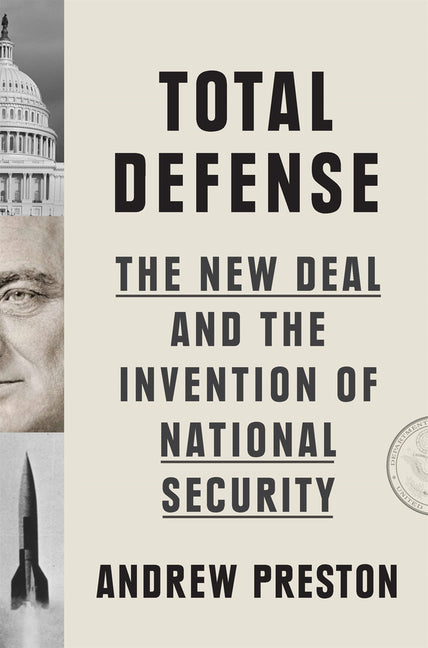
Total Defense: The New Deal and the Invention of National Security


Total Defense: The New Deal and the Invention of National Security
Total Defense: The New Deal and the Invention of National Security
Critical Reviews
Critical Reviews
Every sovereign state must guard its territory and population, but with what scope and resources should they? With characteristic ambition and lucidity, Andrew Preston explains in this rich analytical study of ideas and political culture why the United States, propelled by domestic New Deal liberalism, pursued policies for an expansive and truly global conceptualization of national security.--Ira Katznelson, author of Fear Itself: The New Deal and the Origins of Our Time
In this highly original study, Andrew Preston incisively connects the rise of the American national security state to the simultaneous rise of the American welfare state. No other book so brilliantly captures how a liberal politics of fear and security moved between the arenas of domestic and foreign policy in the 1930s. A major reinterpretation of some of the central events of modern American history, Total Defense counts among the most important books written about the New Deal and its legacy in recent times.--Jonathan Levy, author of Ages of American Capitalism: A History of the United States
Andrew Preston's Total Defense does what the very best history books do: It identifies something we all take for granted--in this case, the idea of a 'national security' establishment--and gives it a history. Less than a century ago, the suggestion that the United States should maintain a permanent military-intelligence-industrial complex would have been anathema to most Americans. Today, it helps to structure the daily lives of billions of people around the globe. Preston shows brilliantly how 'national security' emerged from the same state-building impulses that produced 'social security, ' though with far different consequences.--Beverly Gage, author of G-Men: J. Edgar Hoover and the Making of the American Century
Andrew Preston explains how three distinct areas we often use to divide twentieth-century American history-the New Deal, World War II, and the Cold War-are all connected by a literal bridge in Chicago and a landmark speech Franklin Roosevelt gave to dedicate it in 1937. That is just one of the sparkling contextual insights in this important and urgent book. Preston's sinewy synthesis links Social Security to national security and FDR's 'quarantine' to George Kennan's 'containment' in a timely work that illuminates today's global interdependence and the backlash against it.--Jonathan Alter, author of The Defining Moment: FDR's Hundred Days and the Triumph of Hope
In this expansive and beautifully written book, Andrew Preston illuminates the domestic origins of US national security in the New Deal years. FDR's national security rhetoric laid the ground for confronting the next great threat, global war, and ultimately enabled persistent military engagement to eclipse domestic welfare as the nation's top priority. Highly recommended.--Mary L. Dudziak, author of War Time: An Idea, Its History, Its Consequences
Preston deftly chronicles the evolution of the expansive notion of 'national security' that emerged during the 1930s and then congealed during World War II. This groundbreaking study of the interplay between domestic and international forces in shaping US grand strategy is not only fascinating; it speaks directly to the combination of internal and external challenges the United States faces today.--Charles A. Kupchan, author of Isolationism: A History of America's Efforts to Shield Itself from the World
An incisive reconsideration of a landmark legislative program.-- "Publishers Weekly" (3/23/2025 12:00:00 AM)
Publishing Information
Publishing Information
Publisher:
Belknap Press
Pub date:
2025-05-06
Length:
336 pages
The Allstora Membership
Membership Perks:
- Save 30% on all online store purchases
- Exclusive access to author's content
- You pay less, but authors still earn double
Membership Terms:
First Month:
$0.00
Monthly price:
$5.00
- To access membership discount simply log in and add to cart, discount applied automatically.
- One month free trial, cancel anytime. Membership renews on the 15th of each month.