Economic Government of the World: 1933-2023


Economic Government of the World: 1933-2023
Economic Government of the World: 1933-2023
Description
Description
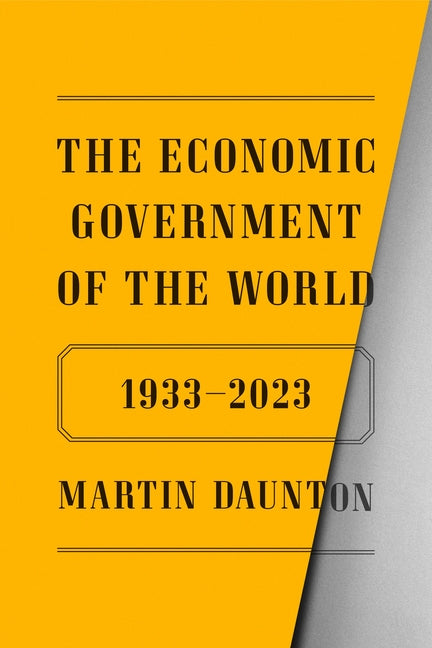
An epic history of money, trade and development since 1933 In 1933, Keynes reflected on the crisis of the Great Depression that arose from individualistic capitalism: 'It is not intelligent, it is not beautiful, it is not just, it is not virtuous - and it doesn't deliver the goods ... But when we wonder what to put in its place, we are extremely perplexed.' We are now in a similar state of perplexity, wondering how to respond to the economic problems of the world. Martin Daunton examines the changing balance over ninety years between economic nationalism and globalization, explaining why one economic order breaks down and how another one is built, in a wide-ranging history of the institutions and individuals who have managed the global economy. In 1933, the World Monetary and Economic Conference brought together the nations of the world: it failed. Trade and currency warfare led to economic nationalism and a turn from globalization that culminated in war. During the Second World War, a new economic order emerged - the embedded liberalism of Bretton Woods, the International Monetary Fund and the International Bank for Reconstruction and Development - and the post-war General Agreement on Tariffs and Trade. These institutions and their rules created a balance between domestic welfare and globalization, complemented by a social contract between labour, capital and the state to share the benefits of economic growth. Yet this embedded liberalism reflected the interests of the 'west' in the Cold War: in the 1970s, it faced collapse, caused by its internal weaknesses and the breakdown of the social contract, and was challenged by the Third World as a form of neo-colonialism. It was succeeded by neoliberalism, financialisation and hyper-globalization. In 2008, the global financial crash exposed the flaws of neoliberalism without leading to a fundamental change. Now, as leading nations are tackling the fall-out from Covid-19 and the threats of inflation, food security and the existential risk of climate change, Martin Daunton calls for a return to a globalization that benefits many of the world's poor and a fairer capitalism that delivers domestic welfare and equality. The Economic Government of the World is the first history to show how trade, international monetary relations, capital mobility and development impacted on and influenced each other. Martin Daunton places these economic relations in the geo-political context of the twentieth century, and considers the importance of economic ideas and of political ideology, of electoral calculations and institutional design. The book rests on extensive archival research to provide a powerful analysis of the origins of our current global crisis, and suggests how we might build a fairer international order.
About the Author
About the Author
Martin Daunton is Emeritus Professor of Economic History at the University of Cambridge, where he was Master of Trinity Hall and on two occasions the head of the School of the Humanities and Social Sciences. He has been the president of the Royal Historical Society, a Commissioner of Historic England, a trustee of the National Maritime Museum, and the chair of the Leverhulme Trust Research Awards Advisory Committee. He has held visiting professorships in Japan and Australia and is a visiting professor at Gresham College.
Critical Reviews
Critical Reviews
"[A] capacious and timely history . . . Offering us a realistic assessment of what American-led governance of the world economy actually entails, Daunton's account is essential reading. Postheroic and disillusioned, this is a history for our times." --Adam Tooze, Financial Times
"A brilliant political, economic and intellectual history that traces the turning points in global economic governance, from the Great Depression to Bretton Woods, from the disorder of the 1970s to the neoliberal triumph of the 1980s and today's perilous malaise." --Max Harris, Times Literary Supplement "[A] sweeping study of international economic institutions . . . Tackling a mountain of material on this complex subject in lucid, elegant prose, Daunton spotlights the constant tension between the elite goal of global economic efficiency and voters' demands on national governments for equality, stable jobs, or welfare spending. The result is a robust history that elucidates the human impact of the machinery of global trade and finance." --Publishers Weekly "The Economic Government of the World is a tour de force. It lets us see the evolving architecture of global economic governance over the last hundred years--the various architects and the designs they favoured, the scaffolding going up (and down), the technicians responsible for fitting out the floors, and the cracks emerging in the walls and foundations. Both in terms of chronological scope and thematic range, I know of no book like it. It is a hugely ambitious and timely work." --Frank Trentmann, author of Empire of Things "Martin Daunton's history of global economic government is rigorous, engaging and astonishing in its range. It shows why any arrangement of the international economic system unavoidably involves political compromise-and concludes with a wise vision of "messy multilateralism" as a path out of our current crisis. A brilliant and important book." --Sunil Amrith, author of Unruly Waters "Daunton's magisterial history is an urgent reminder of the sources and dangers of economic and financial disorder, revealing the interconnections between trade, money, population and development and the hard-fought struggles of leading capitalist democracies to embed the lessons of the past in international institutions. With our world at a critical juncture, the book is a chilling reminder of the risks we face, while offering a positive vision of the way forward." --Patricia Clavin, author of Securing the World Economy
Publishing Information
Publishing Information
Publisher:
Farrar, Straus and Giroux
Pub date:
2023-11-14
Length:
1024 pages

The Allstora Membership
Membership Perks:
- Save 30% on all online store purchases
- Exclusive access to author's content
- You pay less, but authors still earn double
Membership Terms:
First Month:
$0.00
Monthly price:
$5.00
- To access membership discount simply log in and add to cart, discount applied automatically.
- One month free trial, cancel anytime. Membership renews on the 15th of each month.